


Road Rage

When thinking about when someone states to have seen a “car film”, that aforesaid term in reality could/can mean many different films all in one. Indeed, when truly thinking deeply about it, “car films” is in itself an umbrella term for cinematic features that involve the vehicle itself. You not only have something like The Fast and Furious franchise that rather depicts its central conflicts based around the involvement of cars and stunts, but you also have something such as Nicholas Winding Refn’s Drive that although features driving – who would have thought? – its involvement of the car itself is rather accentuated through the drama and romance that is delivered through its central characters. It’s the best “car films” which deploy not only breathtaking vehicle sequences that pit you on the edge of your seat – at times at least – but also pedal-to-the-metal tension that evoke character tension and growth. Much of this is elicited in Joseph Kosinski’s latest cinematic outing in F1, a dramatised sports feature that is fuelled with kinetic direction and editing to bring audiences gripping race-car sequences that are viscerally displayed. Yet, for all of its racing grandeur, does F1 drive itself into the pitting lane for the all narrative cliches money can buy?…
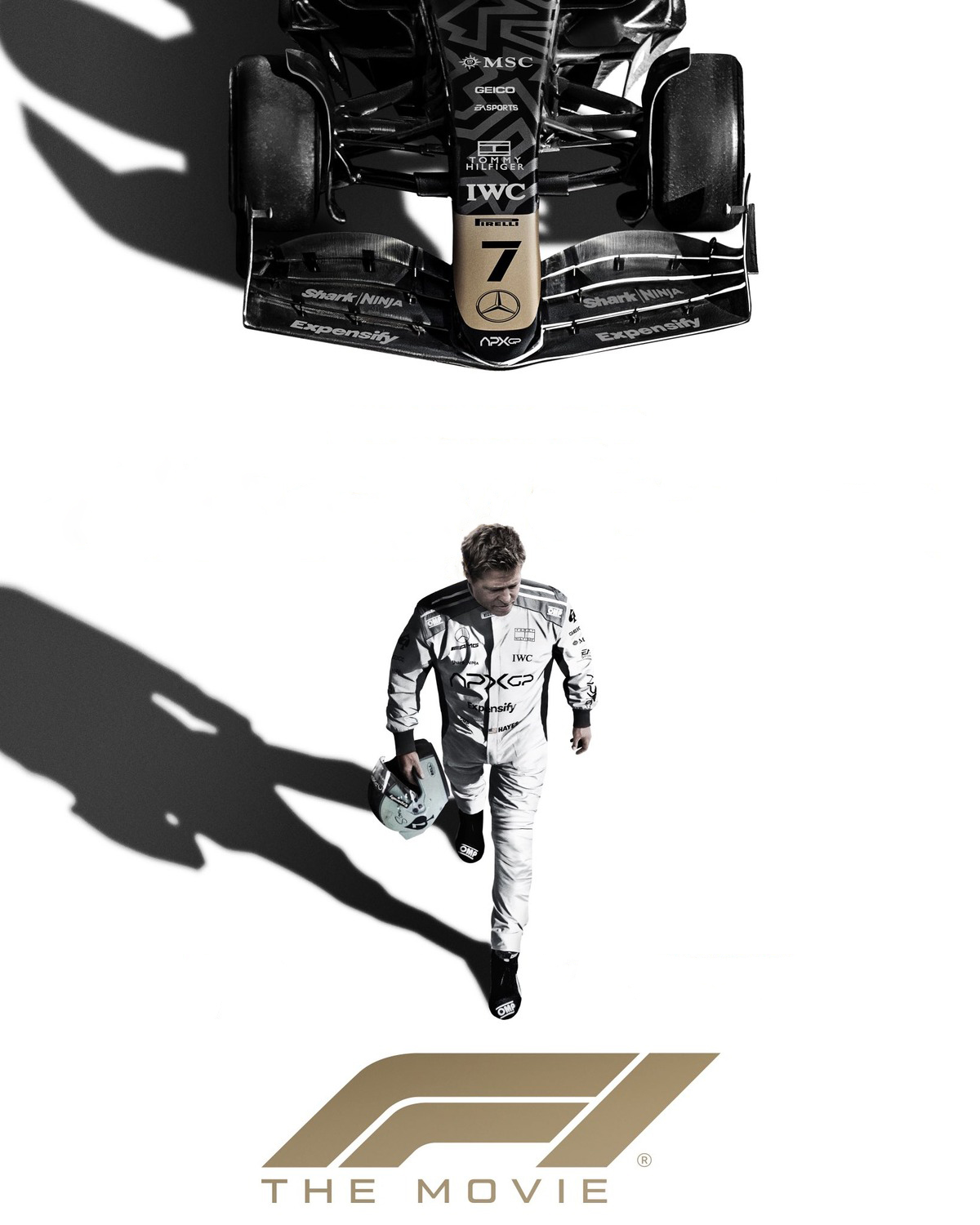
After a nasty incident almost ended his career, Sonny Hayes (Brad Pitt) has retired from Formula One and now races for those who are willing to pay-out. However, when an opportunity comes from the owner of a struggling race team, Sonny makes a return to Formula One racing, alongside a hot new rookie teammate, but soon realises that he can’t take the road on his own and endeavours on a journey for redemption…
As eluded to at the end of my introduction, while every second of racing action in F1 is truly immersive, of which we’ll discuss further, the aforesaid racing feature-film does the opposite for its rather routine narrative and story-points. As much as the vivacious yet dramatised race sequences have their own conceivable twists and turns – where we get to see Sonny and Joshua fight for a place on the podium and how they use each of their respected skill and age to compete against one another and the other drivers, much of the narrative that comprises Kosinski’s film wreaks of the formulaic. Each plot-point that we’re presented with is truly something that can be predicted and, as a result, you can’t help but twiddle your thumbs in wait for when the next story sequence begins knowing what exactly will occur for each respective character. While the proceedings for Sonny and Joshua’s team begins rather hazily, with a few bumps in the road for the said characters’ chemistry and what it means for their racing team, the audience member will undoubtedly roll their eyes knowing what will occur by the time the credits roll onto the silver-screen. In many ways, it shares similarities to that of Neill Blomkamp’s grandiose biopic of Gran Turismo that also features story-points and a narrative structure that screeches familiarity. With this said however, where F1’s story finds triumphs in is not only the chemistry between all the central characters, but in the said film’s narrative thematics. Inherently, it’s rather feasible to perceive with the stemmed friction between the two characters of Sonny and Joshua that there’s this idea around ambition and rivalry and how these two ideas drives (mind the pun) both the seasoned and rookie driver. Where you have Sonny who’s returning to a motorsport that he once knew since yesteryear, you also have a persona in Joshua who is goggled by the prospect of becoming one of the greatest drivers. With these ambitions presented, we’re treated with a rivalry where these characters’ ego’s and aspirations emphasises the competitive nature of the given sport; highlighting how ambition can fuel (I’m one with the puns today) both conflict and collaboration. One particular theme that was subtly threaded through out the moments of tension and build-up to specific moments that I took a notice of is this perception of sports media of today and how obtrusive this aforesaid agency can be in relation to the acuity of a given sport/sports-person. There are a few moments here and there during F1 that illustrates the crude nature of sports media sometimes and how sports personalities can be enveloped by it; consumed to the point where the person of sport are more interested in their perception from the media than their pursuit in the sports itself. The character of Joshua encompasses this where we’re presented with moments where he and Sonny crash-out of a race early in story and while Sonny blasts his team-mate for not embodying his sports mindset, it’s arguable to discern that Joshua is more fixated on his own perception when cameras and sports journalists spring into the scene ready to grasp a moment of the said character in his ‘glory’ despite failing in his drive. It’s an interesting commentary indeed and it’s a shame that there wasn’t more moments like this sprinkled later in the films progression.

Where the story unfortunately folds into a conventional mode of means, every second in which F1 cuts to its racing action is truly thrilling and immersive. In a way, it’s frightening how the film-makers make it look so easy and tangible. Indeed, gone are the days of high-speed action that is succumbed by its own ambition and is forever tangled with the forced-use of CG effects. Groundbreaking new, smaller IMAX cameras sit on the cars, putting you so close to the track you can practically smell the asphalt. Both Pitt and Damson Idris are genuinely behind the wheel most of the time (of modified Formula 2 cars), and shooting at real-life Grands Prix submerges F1 in total authenticity (complete with cameos from drivers, engineers and more). It’s, for sure, a spectacle to behold, especially in races where the editing splices both characters’ perspectives through some enthralling editing techniques and an ending race that marks Hans Zimmer’s score for the film to be one of his best.
For Formula 1 fans, the sheer accuracy of F1’s depiction of the sport will be giddy-making; for agnostics, the races and story developments may feel a touch repetitive, and the level of detail may go over some heads for those unacquainted. But whatever your relationship to the sport, the magnitude of what Kosinski and co have accomplished is undeniable. With the use of smaller IMAX cameras, it’s a must to see Kosinksi’s latest filmic creation on the biggest screen possible.
★★★☆☆ – Alex Rabbitte