


Irony Abounds…

Live-action animation hybrids have always occupied a strange corner of cinema. From the technical wizardry of Who Framed Roger Rabbit? to the cartoon chaos of Space Jam, and more recently the big-screen rehabilitation of characters like Sonic the Hedgehog, Hollywood has repeatedly attempted to convince us that animated characters and flesh-and-blood humans belong in the same world. Indeed, some films of this nature utilise the contrast between the two mediums to highligh the wonder of a reality that’s more vibrant than the one we’re used to. Others take the opposite approach, pretending cartoon characters are just another actor for a metatextual disconnect. In the case of Coyote vs. Acme however, it finds an unexpectedly clever way into the formula. Rather than simply dropping a Looney Tunes character into our world for nostalgia’s sake, director Dave Green asks a perfectly reasonable question: after decades of faulty rocket skates, malfunctioning catapults and explosions to the face, why hasn’t Wile E. Coyote sued somebody?
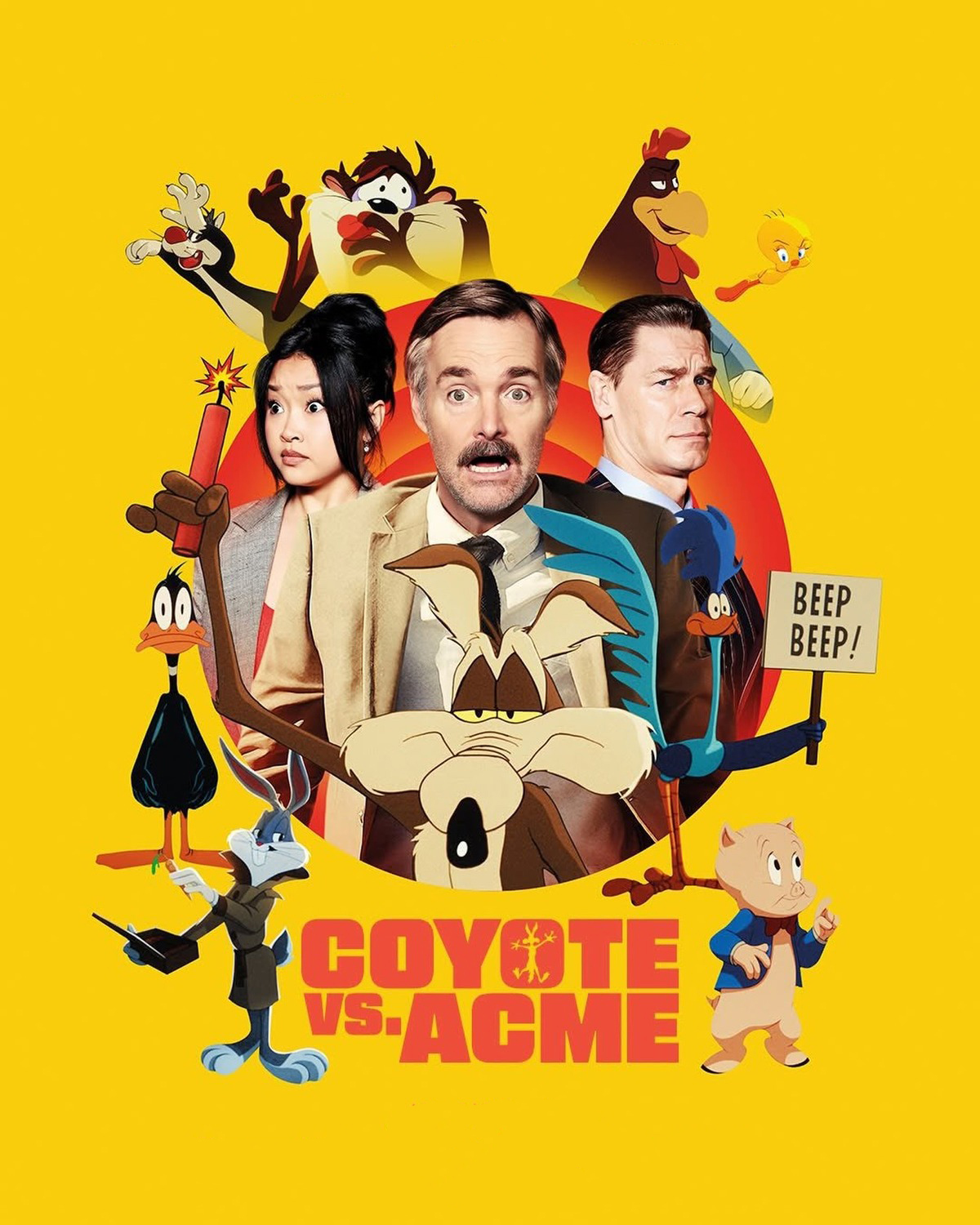
The answer forms the basis of a surprisingly inventive courtroom comedy. After a lifetime of purchasing increasingly elaborate contraptions from the Acme Corporation, only for each one to backfire with spectacular and often physically devastating consequences, Wile E. Coyote finally decides enough is enough. Unable to speak, but more than capable of communicating through his familiar expressions and hand-drawn signs, he seeks legal representation from Kevin Avery (Will Forte), a struggling personal injury lawyer whose professional life is going nowhere fast. Together, the unlikely pair launch a lawsuit against Acme, the enormous corporation responsible for supplying the Coyote with virtually every defective gadget that has ever sent him plummeting off a cliff. Standing in their way is Acme’s slick and intimidating lawyer Buddy Crane (John Cena), who represents the corporate machine with the kind of polished confidence usually reserved for people selling something they absolutely should not be trusted to sell. As the case grows larger, Kevin and Wile E. find themselves taking on not just a company, but an entire system built around profit, influence and avoiding responsibility…
Where the film truly excels is in its handling of slapstick. This is, after all, a movie starring Wile E. Coyote, and failing to include a healthy number of anvils, explosions and catastrophically misjudged inventions would be cinematic malpractice. Thankfully, Green and his creative team understand exactly why the original Looney Tunes cartoons worked. What’s so crude in regards to making slapstick comedy is how hard it is to get the comedy to work and how it’s very easy to get it wrong .The slapstick here is not merely there to remind audiences that they are watching a Looney Tunes film; it is woven directly into the story and characterisation. Every explosion carries decades of cartoon history behind it, while the film finds new ways to translate Wile E.’s silent suffering into live-action comedy. More impressively, the humour sits comfortably alongside the film’s surprisingly sharp commentary on corporate greed. Acme is presented as an all-consuming conglomerate, happy to sell dangerous products while hiding behind lawyers and public relations. There is something deliciously ironic about watching a film owned by one of Hollywood’s biggest studios take aim at the kind of corporate behaviour that increasingly dominates the entertainment industry. The jokes may involve rocket skates and dynamite, but the target is unmistakably real.

That irony becomes impossible to ignore when considering the film’s own history. Coyote vs. Acme was famously completed before Warner Bros. shelved it in 2023 as part of a tax write-off strategy, despite reportedly receiving positive responses from early screenings. For a time, it appeared that the finished film would simply disappear, joining an increasingly worrying list of completed projects sacrificed for corporate accounting decisions. The backlash from filmmakers, audiences and industry figures was considerable, and the film was eventually rescued when Ketchup Entertainment acquired the distribution rights. Its eventual release gives Coyote vs. Acme an additional layer of meaning that no screenwriter could have planned: a film about a small, battered underdog fighting a giant corporation was itself nearly destroyed by one. Wile E. Coyote has spent decades being flattened by boulders and blown up by his own equipment, but even he might have struggled to survive Hollywood accounting.
Ultimately, Coyote vs. Acme works because it understands that the best Looney Tunes stories have always had more intelligence behind them than their anarchic violence suggests. It successfully combines the visual invention of classic cartoon slapstick with a genuinely engaging courtroom story and a surprisingly relevant critique of corporate power. Will Forte provides the necessary human heart, John Cena clearly relishes playing against type, and Wile E. stands as a resolute silent comedians. Most importantly, the film never allows its commentary to overwhelm its sense of fun. This is still a film where someone can be hit by an anvil and where a badly designed rocket can turn an ordinary journey into a disaster. But beneath the explosions lies a pointed message about what happens when corporations become too large to care about the people – or coyotes – affected by their decisions. After nearly becoming a corporate casualty itself, Coyote vs. Acme finally reaching cinemas feels like a victory. Meep meep, indeed!
★ ★ ★ ★ ☆ – Alex Rabbitte