


Flashbacks Galore?

Truly, gone are the years now where the general audience view the Japanese Animated medium as a visual outlook that is ‘niche’. While notable works by Studio Ghibli, especially in the past and more recently earmarked by Hayao Miyazaki’s The Boy and the Heron, have long paved the way for international audiences to perceive culturally specific stories – set in Japanese society or drawing on Japanese aesthetics – that are expressed in the most vivid and most tangible ways, it’s fair to assess that the films that have been distributed and produced from said medium in recent years (such as Your Name, Weathering With You, and Suzume) have equally established this cultural success. At the same time, adaptations of ongoing anime/manga series into feature-films have boomed, especially when they combine strong source material, high production values, and international marketing. Within that trend, Demon Slayer: Kimetsu no Yaiba has become something of a phenomenon. The 2020 film Mugen Train not only broke Japanese box office records, but demonstrated how faithfully adapting popular recent manga/arcs, with cinematic enhancements, can deliver both for fans and general audiences. Infinity Castle steps into that tradition: it is the first part of a trilogy adapting the manga’s final arc, produced by Ufotable, a studio already renowned for its high-quality animation, meticulous details, and ability to deliver spectacle with emotional resonance. With all the hype around it however, does Infinity Castle compare to its preceding anime collaborators that remained in the hearts of many?
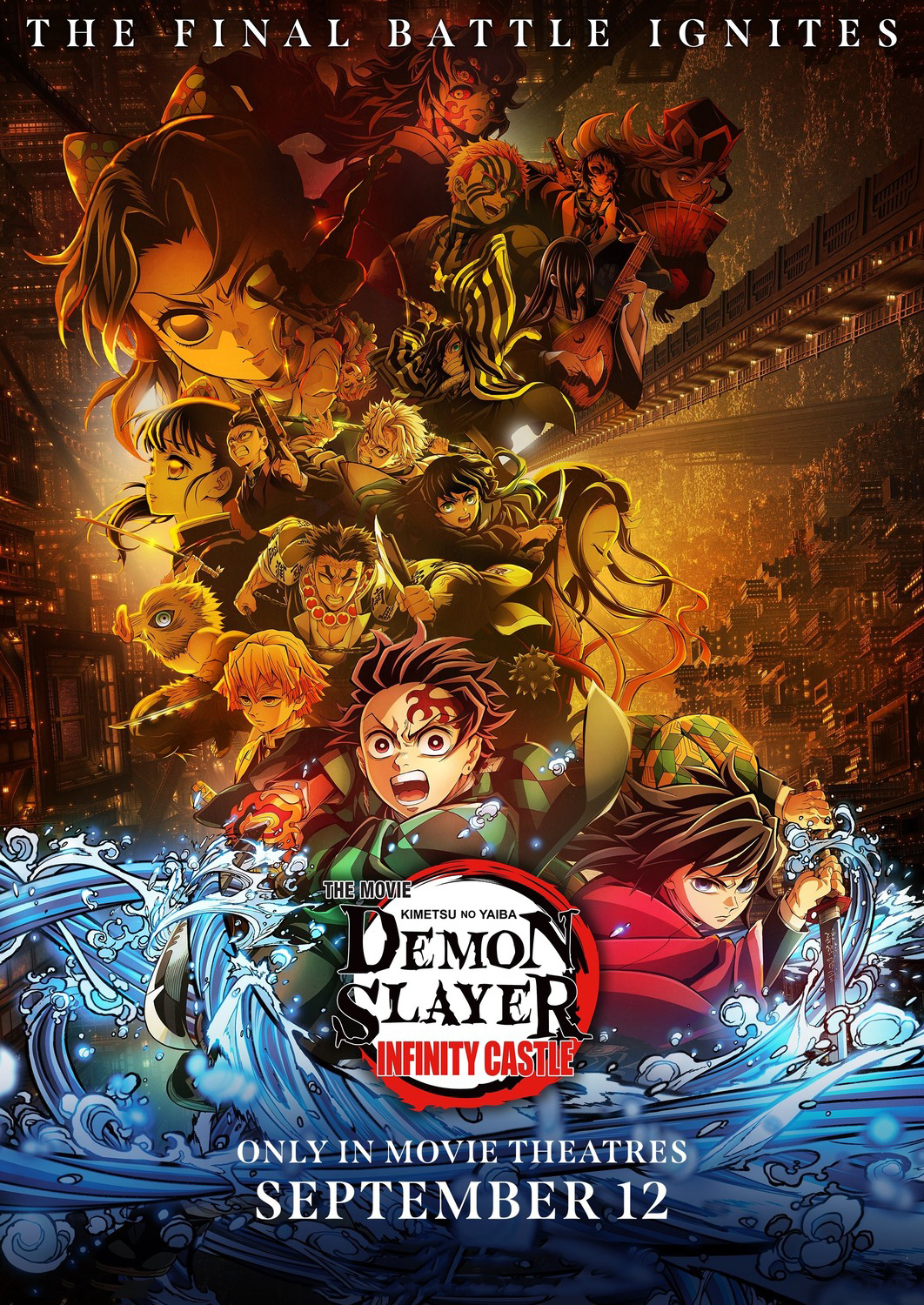
Infinity Castle picks up after the Hashira Training arc (which itself followed much buildup in the TV series and earlier films). The Demon Slayer Corps, rallied and reeling, are drawn into Muzan Kibutsuji’s lair, the Infinity Castle—a realm under his control, one which distorts space, time, gravity, corridors, windows, rooms.
Inside, the slayers confront members of the Twelve Kizuki (the highest demons under Muzan), including Upper Ranks and many others. While Shinobu, the insect Hashira, quickly encounters the very same demon that killed her older sister long ago, The likes of Zenitsu and Tanjiro are both drawn towards their own respective battles that elicit encounters with familiar faces. Alongside the action, the film intersperses flashbacks: of demons’ pasts, of the slayers’ own motivations, traumas, and what got them to this pivotal confrontation. The Infinity Castle itself serves as a shifting battlefield and symbolic embodiment of inner conflict—of corruption, identity, and the monstrous vs. human.
With the final cliffhanger of Tanjiro forever falling within Muzan’s ever-changing and moving Infinity Castle in the 4th season of famed T.V. series, the film of the same name expectedly had much anticipation going into it. Indeed, the ending to the preceding season rather elicited a pining feeling; with the devoted audiences members wanting more while knowing that this set of three films would undoubtedly deliver a spectacle that would be loving remembered and adhered to. The first of these films, Infinity Castle, truly doesn’t disappoint and marks its territory from the get-go. The films magically keeps the same tense and heightened energy from the end of the previous season where our sword-wielding heroes are thrusted within an altering cinema-scape that provides uncertainty for even our viewing pleasure; with twists and turns and fateful encounters that tests the skill and resolve of characters audiences have come to know and adore. What’s noticeable to behold however, after the fact of watching this aforesaid feature, is the ever clear and transparent use of a omnipotent narrative device – flashbacks. renowned for the implementation of this to create a heightened sense of emotion and empathy for the demons specifically, Infinity Castle’s narrative is largely interwoven through the present battle with flashbacks to both the demons’ histories and the slayers’ personal pasts. These serve to deepen characters, motives, and emotional stakes. However, the use of flashbacks is double-edged. While they enrich, they sometimes interrupt momentum (especially in high-tension fight sequences). This closely links to this feeling of the film feeling like a concatenation of episodic fights rather than a single, tightly woven narrative. There are breaks between major showdowns, and some parts where focus shifts among several characters. This can lead to a sense of uneven pacing: some fights or arcs feel very well built; others feel like padding or recap. This, I feel anyway, seems certainly true considering how the audience members at my cinema viewing were disengaged with the over-reliance of the context and were more languishing the thrilling situation of the characters fighting their way through this ever-shifting labyrinth of a castle. That being said, as clunky as the pacing in Infinity Castle can be at times, it’s very rarely to the point that it becomes detrimental to the overall experience. The film’s strengths lie in how it uses its battles to explore character. For instance, Zenitsu and Kaigaku’s confrontation is as much about past relationships, regrets, and choices as about raw power. Tanjiro’s fight with Akaza likewise is more than physical: it’s tied to grief, loss, guilt, and the question of what it means to remain human (or demonic). This specific bout wholly corelates to the films central themes of inner struggle; how easily one can succumb to ill intent and easily lose what it was that they were striving for in the first place. The emotional payoff here is substantial, especially for long-time fans who have followed these arcs over many episodes.

As one would expect from viewing the series, one particular area of the film to glorify in is the overall direction of the formative techniques. for years now, Ufotable has had a reputation for producing some of the most visually stunning and all-around gorgeous anime a person can watch, and Demon Slayer: Kimetsu no Yaiba has been one of the best examples of what they’re capable of. The said animation studio continues its reputation for combining traditional 2D character art with CGI environments and effects. Battles are rendered with care: elemental visual motifs (water, flame, thunder, poison, ice) are given distinct textures and weight. The contrast between light and shadow is used well—Muzan’s realm is often dim or foreboding, with flashes of color when techniques or emotions spike. Backgrounds are detailed; costumes and traditional Japanese motifs (e.g. the Taishō era setting, dress, architectural allusions) help ground the fantasy in a specific cultural and temporal setting. The soundtrack also adds a lot to the overall direction, as Yuki Kajiura and Go Shiina’s score never fails to perfectly sell a scene through either gorgeous instrumentals or their signature incomprehensibly beautiful vocal tracks; the two have been mainstays for Demon Slayer and Ufotable for years now, and Infinity Castle might be their best work yet.
With all that’s been said, the question remains is – does Demon Slayer: Infinity Castle live up-to fans’ expectations? Indeed, with Infinity Castle just being the next arc in the Demon Slayer story, it’s easy to write it off as just an inflated form of the Demon Slayer anime, and parts of the film don’t necessarily justify the theatrical experience, especially when it comes to some of its pacing issues. Even the narrative itself is one which doesn’t truly behold any form of creativity, since the animated feature rather bounces from one perspective to the next in a rather visually sumptuous conveyor belt. That said, all of this doesn’t take away the fact that Infinity Castle will be marked as one of the greatest cinematic experiences in recent memory. It’s a feat that not a lot of other animated series would dream to hope for, yet it’s Demon Slayer that takes the cake! What’s even better to think about as well is the fact that its final storyline is far from over…It’s just we’ll have to a wait a few years for its second coming now…
★ ★ ★ ★ ☆ – Alex Rabbitte